
Vegan candy sounds simple in theory. No meat. No dairy. No gelatin.
Yet in practice, sweets are one of the product categories where ingredient transparency matters most.
If you already live plant based, the routine is familiar. You scan for gelatin. You double-check milk powder. You pause at anything glossy or intensely coloured. Candy is rarely complex in structure, but it often becomes complicated in sourcing.
The irony is that most hard sweets do not require animal-derived ingredients at all. From a food science perspective, sugar, glucose syrup, flavourings, food acids, and colourings are sufficient to create structure, intensity, and shelf stability. The real difference lies in formulation choices and supplier verification.
So what actually makes candy vegan?
How do E-codes fit into the picture?
And how can consumers choose vegan sweets with confidence, without turning every purchase into a label investigation?
Let’s look at it properly.
What makes candy non-vegan?
Most non-vegan sweets rely on a small group of familiar ingredients. Gelatin is used for elasticity in gummies and soft fillings. Dairy derivatives such as milk powder or whey add creaminess or flavour depth. Certain colourings and coatings still come from animal sources.
While these ingredients are unnecessary in hard candy production, they remain common across the wider confectionery market. That is why even experienced vegans continue to read labels carefully.
A vegan candy should be clearly dairy free, gelatin free, and made without animal products.
Not implied. Not assumed. Verified.
Vegan candy checklist - Ingredients that are not vegan

Before choosing your sweets, take a moment to check these ingredients that can make candy non-vegan.
Gelatin (E441)
The most common non-vegan ingredient in sweets. It is derived from animal collagen and used mainly in gummies, marshmallows, and soft fillings.Milk, milk powder, skimmed milk powder
Any direct dairy ingredient automatically disqualifies a product from being vegan.Whey, whey powder, lactose
All are dairy derivatives, even if they appear in small amounts.Casein or caseinate (E469 may be plant-based, but casein itself is dairy-derived)
Casein is a milk protein and not vegan.Butterfat or milk fat
Clearly animal-derived dairy components.Carmine (E120)
A red colouring made from crushed cochineal insects. Not vegan.Shellac (E904)
A glazing agent derived from insect secretions. Often used to create shine on coated sweets.Beeswax (E901)
Used as a coating or glazing agent. Not vegan.Ingredients that may be vegan, depending on sourcing:
Some additives are vegan in many cases but require confirmation:
Mono- and diglycerides of fatty acids (E471)
These can be plant or animal derived. Without clarification, sourcing is unclear.Glycerol (E422)
Often plant-based, but can be animal-derived depending on production method.Stearic acid (E570)
Can come from plant or animal fats. Needs sourcing confirmation.
Are all lollipops vegan?
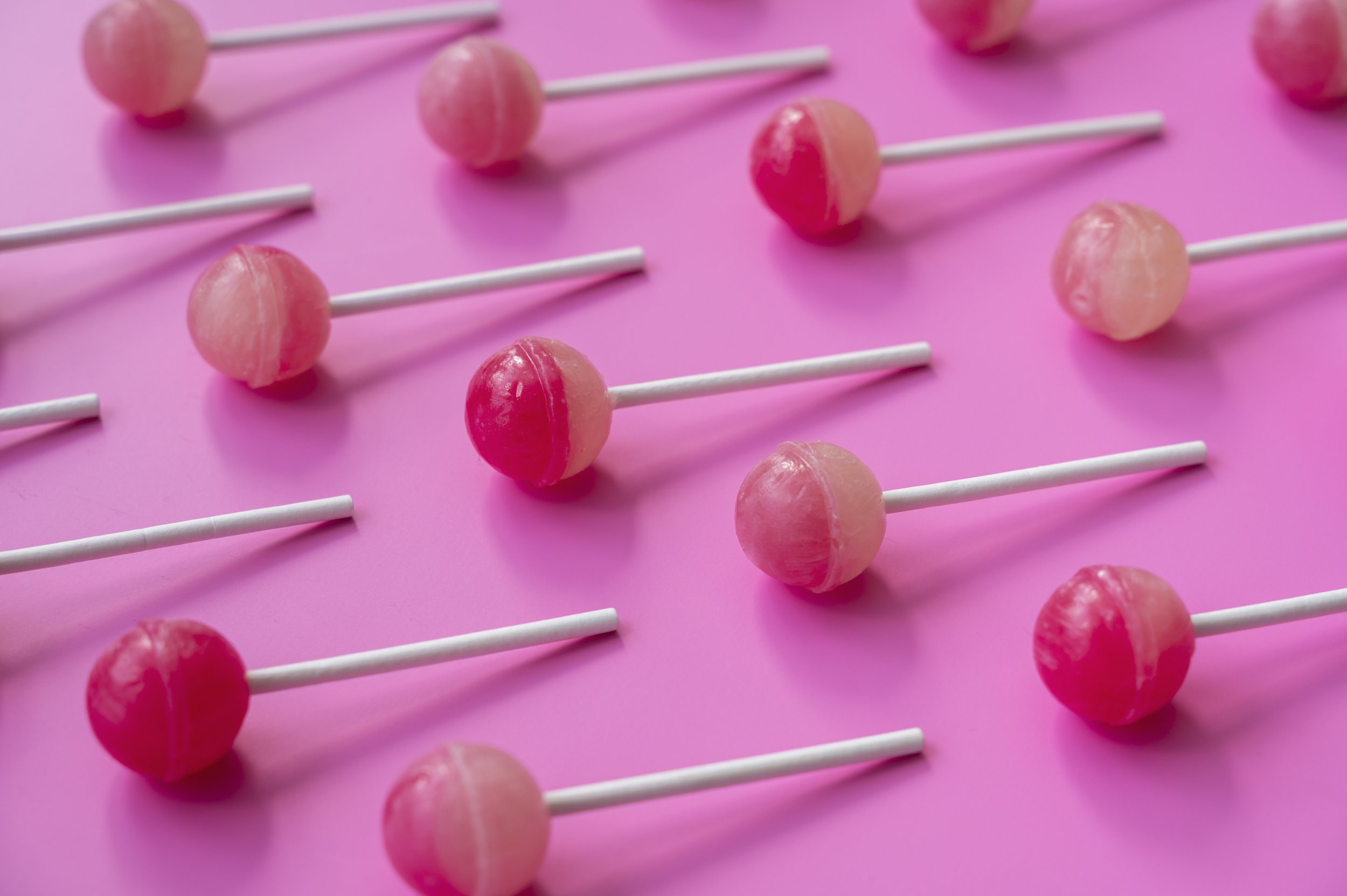
It is easy to assume that most hard lollipops are accidentally vegan, and sometimes that is true. However, assumptions are not the same as standards. Some lollipops contain fillings that include dairy, while others use glazing agents that may not be plant-derived. Even sugar processing methods can vary depending on sourcing.
Clearly labelled vegan lollipops remove this uncertainty. When a product is intentionally formulated and verified as plant-based, consumers can choose with confidence rather than guesswork.
Non-vegan surprises:
While many hard lollipops are plant-based, several popular variants from major brands contain dairy ingredients or animal-derived components:
Milk-filled lollipops from Chupa Chups (such as creamy or “milky” centre variants) – these typically contain milk powder or whey.
Tootsie Pops by Tootsie Roll Industries – the chocolate-flavoured centre contains dairy ingredients, making the product non-vegan.
Cream-filled seasonal or novelty lollipops across multiple confectionery brands – many include milk-based fillings even when the outer hard candy shell is plant-based.
These examples highlight why checking labels remains important. Even when the outer lollipop appears identical to standard hard candy, fillings, coatings, or flavour inclusions can change the vegan status of the product.
What about E-codes in vegan candy?
E-numbers often create confusion, but they are simply standardized codes for approved food additives within the European Union. Some are synthetic, many are plant-derived, and a few can be animal-derived depending on their origin.
An E-code alone does not determine whether a product is vegan. Citric acid, for example, is typically produced through fermentation and is fully vegan. Many colourings used in vegan sweets are synthetic and contain no animal components. What matters is sourcing transparency.
A lollipop can contain E-codes and still be fully vegan as long as none of those additives originate from animal sources.
The rise of vegan sour candy
Sour confectionery is one of the fastest-growing segments within vegan candy. Vegan sour sweets work particularly well in plant-based formulations because they rely on sugar and food acids such as citric or malic acid to create intensity. The sharp sweet-and-sour contrast comes from chemistry rather than dairy or gelatin.
When flavour balance is properly executed, vegan sour candy delivers the same complexity and satisfaction as conventional sweets — with no compromise in structure, only a difference in sourcing.
Where brands approach it intentionally
As the vegan candy market continues to evolve, the difference between superficial reformulation and intentional plant based development becomes increasingly visible.
Some manufacturers remove gelatin and stop there. But a truly vegan product requires more than a single substitution. It involves reviewing colour sources, confirming that emulsifiers and additives are plant-derived, verifying E-code origins, and ensuring dairy is excluded throughout the entire formulation process.
Several brands have taken this approach seriously. Companies such as Katjes or Candy Kittens, have built strong reputations around clearly labeled vegan sweets. At the same time, brands like Bubbly Billy Candy are contributing to the category with plant based confectionery designed from the start to meet vegan standards.
Bubbly Billy Candy lollipops are developed as vegan candy by formulation, not by adjustment. They are dairy free, gelatin free, and contain no animal products. Like other responsibly produced vegan sweets, they may include approved E-codes, but these are sourced in alignment with plant based requirements.
The same principle applies across leading vegan-friendly brands: ingredient transparency, supplier verification, and flavour integrity go hand in hand. Especially in categories such as vegan sour candy and vegan sour lollipops, structure comes from sugar chemistry and food acids, not from animal-derived ingredients.
Are vegan sweets also halal or kosher?
There is often overlap between vegan candy, halal candy, and kosher candy. Because vegan sweets exclude meat and dairy, they already avoid many restricted ingredients.
However, halal lollipops and kosher lollipops require certification based on production processes and sourcing, not just ingredient lists. Vegan status alone does not automatically guarantee certification.
For consumers who require halal or kosher assurance, official labelling remains essential.
Why vegan lollipops make sense
From a formulation standpoint, hard candy never required animal-derived ingredients in the first place. When ingredients are sourced carefully and transparency is prioritised, vegan lollipops simply reflect good product design.
They align with plant-based standards, maintain full flavour integrity, and remove unnecessary animal inputs from a category that functions perfectly well without them. For today’s consumers, this is not only an ethical preference but also a practical one: sweets that deliver the same taste and enjoyment with clearer ingredient confidence.
When choosing sweets, clearly labelled products make the process easier and remove uncertainty around sourcing and formulation. Consumers who prefer verified plant-based options can explore our selection of vegan lollipops, where each product is developed without gelatin, dairy, or animal-derived ingredients, allowing shoppers to choose confidently without relying on guesswork.